How learners can study smarter, not harder

Written by: Dr Rahaf Omran
Whilst we live in the era of information abundance, one is simply unable to retain as much information as one wishes. This particularly applies to students in the healthcare sector, where they are not only required to acquire considerable loads of information in a relatively short time but are also expected to retain this knowledge throughout their careers.
How can this be done?
Multiple individuals advocate that students should spend an average number of hours revising and studying each day to maintain their knowledge and skills. Whereas, on the other hand, others claim that healthcare-related students will only efficiently retain the masses of information they are supposed to retain when they graduate and start practising, as they will have no other choice but to remember, and their brains will adapt to a load of required data, as a result. However, after ten years of higher education in dentistry, I have a different opinion.
My name is Rahaf Omran, and I have been teaching undergraduate healthcare students for five years. When I started this journey, I researched the best methods of educating students so they not only benefit from the content I am providing, but also retain the knowledge as efficiently as possible. Throughout this research, I learned about a very interesting phenomenon, called “The forgetting curve”. Basically, this is the brain’s pattern of not holding onto pieces of information unless they will consistently benefit from it. For example, we all have experienced forgetting a person’s name if we only met them once. The brain might voluntarily let go of that piece of information as it might not be of use if we are never to meet this person again. However, the brain cannot basically differentiate between a stranger’s name and the empirical information you might need to save someone’s life!
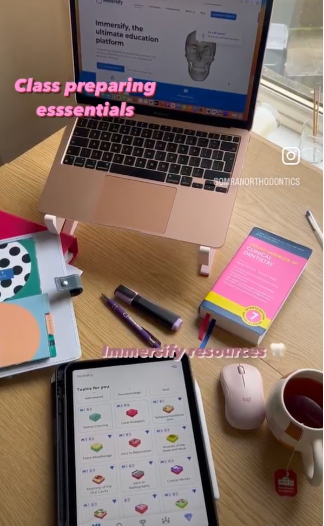
Therefore, researchers have been trying to combat this forgetting phenomenon. Research suggests the way to do that is by reminding the brain of the information every so often. This is termed: “spaced repetition”. It has been evidenced that by recurrent exposure to important information, the brain comes to identify the knowledge as “important”, and therefore the speed at which the forgetting happens is slower. The number of exposures can vary between different individuals, and the knowledge we need in our everyday practice is somewhat fixed in our brains. Immersify Education, being one of the pioneers in dental education, have built their educational platform around this very educational theory. Both the website and the Immersify application provide chances for periodic revisions, whether it is by using their end of lesson quizzes, MCQs or VMCQs.
Using these teaches the learner’s brain that instead of waiting until it has no other choice but to keep the information, i.e. in clinical scenarios, that students can take advantage of the forgetting curve phenomenon to hack their brain’s potential to retain information.
This is not only effective but also fun! Check out the Immersify Platform to gain a deeper understanding of how this works.
Try for yourselves, thank me later!
Is revising enough?
Some students say: “I revised the material time and time again, and yet, I do not seem to really remember the content!”
Our brains tend to let go of any pieces of information that are not of instrumental value to them. So frequent exposure to this information persuades the brain to retain this knowledge, as it is deemed important. The Immersify Platform is built with this theory in mind and can help students retain information more easily.
However, to gain an even better benefit from the phenomenon, researchers have found that there is a difference between simply reading the information, i.e. revising it, and actively recalling it. To put it simply, we all have experienced trying to remember someone’s name. you would say oh god I knew this person’s name what was it? And you will keep on digging in your memories, searching for what that name was. If you manage to recall it you would be like AHA! I remembered.
Now this, my friends, is like a reward to your brain. A hit of dopamine is released, and it is your brain’s favourite reward.

As a result, researchers have employed this exact scenario to create an educational method termed “Active Recall’. In a nutshell, it means that you quiz yourself, and take time to recall the answers! For example, if you needed to remember the symptoms of a given disease, you would simply take a couple of minutes to recall this. Try and look as hard as you can in your memories, for anything you know about this condition. Write that down and then look up the answer. It has been evidenced that if this is done frequently, more stable mental connections, i.e. better information retention is achieved. Or for a quicker, more fun method, you can use Immersify’s Human Diseases MCQs!
With this in mind, the Immersify Platform relies heavily on quizzes, MCQs, and other types of testing such as flagging the correct bones or muscles. Testing as an educational theory is not only effective, but it can also highlight strengths and weaknesses, so learners can better allocate study time to different topics.